Are record player needles universal? How to find the right one for your deck
As an Amazon Associate we earn from qualifying purchases. This page contains affiliate links — if you buy through them, we earn a small commission at no extra cost to you.
When you see a needle listed as ‘universal’, that label can only ever refer to the cartridge mount interface, never the stylus profile itself. True compatibility is a two-step check you perform on your own deck: first the physical mount, then the stylus shape. A needle made for an Audio-Technica VM95 cartridge, for example, won’t physically slot into an Ortofon 2M housing, and a P-mount deck requires a specific adapter like the AT-PMA1 for T4P cartridges. The shape, the mount, and the tracking force are all different; buying the wrong one wastes money and risks damaging your records.
The “Universal” Myth: Mount and Profile Are Separate
Sellers use “universal” as a marketing term, not a technical specification. It often describes a range of cartridges from the same family, or helps a listing appear in more searches. It does not mean the part fits every turntable.
Incompatibility runs deeper than brand names. Cartridges use specific mount geometries. P-mount (T4P) cartridges have a small, square plug, while the more common integral mount uses a larger rectangular body. A needle sold as “universal” for one mount type will not fit the other.
The stylus shape is the second layer. The tip contacting the groove comes in conical, elliptical, and line-contact profiles, each designed for a specific cartridge. Using a mismatched stylus shape—like a conical on a cartridge designed for an elliptical tip—means it won’t track the groove correctly. This can lead to uneven wear and affect sound quality.
Tracking force adds another variable. Every cartridge specifies a recommended downforce in grams. If you fit a replacement with different force requirements, you risk under-tracking (skipping) or over-tracking (accelerated groove wear). A new needle that “sounds worse” often just needs a different force setting.
Spending a few minutes to find the right needle is cheap. Getting it wrong costs you the price of the part and potentially a damaged record.
How to Find the Right Needle
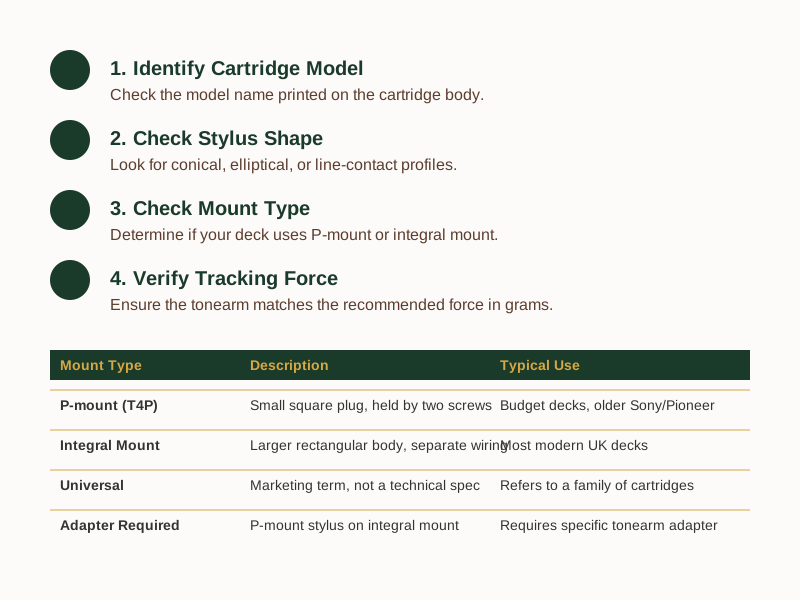
Identify your cartridge model before you buy anything. Don’t skip this step.
Locate Your Cartridge Model
Check the cartridge body. Most have the model name printed on the front face. On an Audio-Technica deck, you might see AT-VM95E (paid link). On an Ortofon, look for 2M Red (paid link) or 2M Blue. If the text has worn off, check your turntable’s manual; it usually lists the factory cartridge.
View AT-VM95E on Amazon → (paid link)
This model number is your starting point.
Identify the Stylus Shape
Once you have the model, examine the stylus tip with a magnifying glass or phone camera. The three common profiles are:
- Conical: A rounded tip. Forgiving on wear, retrieves less fine detail.
- Elliptical: An oval-shaped tip. Makes better contact with the groove walls for more detail.
- Line-contact / MicroLine: A narrow, rectangular tip. Closest to the original cutting head, offering the best detail retrieval but demanding precise setup.
Many cartridges are sold as a body-and-stylus set where the stylus is replaceable. The Audio-Technica VM95 range illustrates this: the AT-VM95E (paid link) body takes an ATN95E stylus. Buy the stylus code that matches your cartridge model exactly.
Confirm the Mount Type
Unsure if your deck uses P-mount or integral mount? Look at the cartridge shape. P-mount cartridges are slim and squarish. Integral mount cartridges are larger and attach with two small screws to a headshell, with visible wiring.
Match the Tracking Force
Before buying, find your cartridge’s recommended tracking force—it’s on the manufacturer’s spec sheet or original box. Your tonearm’s counterweight needs to be set to match. If you’re unsure how, our guide to setting up your turntable covers the basics.
With the cartridge model, stylus shape, and mount type confirmed, you can buy confidently.
Keep these steps handy—get the Free Record Care Checklist for a quick reference when you’re shopping.
Pitfalls to Avoid When Buying a Replacement
Forum threads reveal a few common errors.
Buying by turntable brand instead of cartridge model. Saying “I need a needle for my Sony turntable” often leads to the wrong part. The cartridge inside is what matters, and two decks from the same brand can use different ones.
Mistaking a dirty record for a worn needle. A damaged tip causes crackle and skipping, but so does dust. Before buying a new needle, clean the record—and the stylus itself. A stylus brush with a little isopropyl alcohol (used carefully) can revive a needle that’s just gummed up.
Overlooking the ground wire. A missing or loose ground wire between the turntable and phono preamp causes a hum. This is separate from needle issues, but people sometimes blame the stylus. If the hum is present with the volume up but the record quiet, check the ground wire connection first.
Assuming “compatible” means “identical.” Some sellers list replacements as compatible with a range of cartridges. Sometimes that’s accurate, but it can also mean “fits a similar-sized mount.” Read the specifications carefully and match the stylus code exactly.
What Replacement Needles Cost in the UK
Basic replacements for common cartridges typically cost around £15–25. Mid-range replacements for popular models like the VM95 or 2M Red (paid link) are usually £30–75. High-end stylus upgrades with line-contact profiles or nude diamond tips can run from £95 to over £160.
See 2M Red on Amazon → (paid link)
You might find vintage replacements for less. Specialist audio suppliers sometimes stock older stylus codes that general sites don’t carry. The catch is that vintage stock can be inconsistent—internal rubber dampers may have hardened—and availability isn’t guaranteed.
Where you buy matters. Specialist audio retailers understand the codes and compatibility. General e-commerce platforms have more stock and lower prices, but the risk of non-genuine replacements is higher. A deal that looks too good to be true on a long-discontinued stylus code probably is.
Matching the upgrade to your deck is key. Owners who buy the correct £30 replacement often report clearer, tighter sound. Those spending £150 on a premium stylus for a basic deck might find the improvement subtle, as the rest of the system (amp, speakers, pressings) becomes the limiting factor.
If you invest in a better stylus, pair it with clean records. A new needle on a dirty pressing wastes the investment.
Cartridge Mount Types & Compatibility
| Mount Type | Description | Typical Use |
|---|---|---|
| P-mount (T4P) | Small square plug, held by two screws | Budget decks, older Sony/Pioneer models |
| Integral Mount | Larger rectangular body, separate wiring | Many modern decks, audiophile gear |
| Adapter Required | P-mount stylus on integral mount | Requires specific tonearm adapter |
The Right Needle for Your Deck
“Universal” needles don’t exist in any practical way. You need the stylus code that matches your cartridge model, in the profile you want, at a sensible price for your setup. A little time identifying your cartridge saves the hassle of returns.
If you’re new to this and want a quick reference—what to check and what to avoid—that’s what the free checklist is for.
Get the Free Record Care Checklist — vinylandturntable.co.uk/free-checklist/
Where This Checklist Doesn’t Apply
This guide focuses on decks with user-replaceable cartridges. If you have an integrated or fixed-cartridge deck (common on many entry-level models), the needle is often not user-replaceable. For those, you’ll need to look up your specific turntable model to find the correct part or service option.
Related Guides
For a complete overview, see our How often should you replace a record player needle? What the “1,000 hours” rule really means .
Sources & Further Reading
As an Amazon Associate we earn from qualifying purchases. The products linked above are ones we recommend based on independent research and owner feedback.
Note: General guidance only, verify details with a qualified professional or official source.