Carbon-fibre brush, spray or wet clean: which method your records actually need
As an Amazon Associate we earn from qualifying purchases. This page contains affiliate links — if you buy through them, we earn a small commission at no extra cost to you.
Cleaning vinyl is a job that escalates. The right method isn’t a choice between three options, but the lowest rung on a ladder that solves your specific problem. At the bottom sits the carbon-fibre brush—dry, quick, for surface dust. One rung up, spray cleaners handle damp, localised spots. At the top, full wet cleaning tackles grime that’s bonded to the groove. The goal is to find the cheapest method that actually removes the contamination you’re hearing, because buying a wet-cleaning machine for a job a brush could handle is wasted money.
The decision rests on what’s in the groove. A tick on every rotation isn’t always a worn needle. Often it’s contamination the brush pushed aside but couldn’t shift—fingerprint grease a brush can’t grip, or grime settled into the groove wall over years. They aren’t interchangeable tools.
Here is what each method actually does, which situation calls for which, and why the sequence matters.
Contamination sits in two places
A vinyl groove is a fraction of a millimetre wide. The stylus tracing it is smaller still. What sits in the groove isn’t a uniform layer; it’s two different types of contamination in different places, and that determines which cleaning method works.
Loose surface material—fibres from sleeves, atmospheric dust—sits on top of the groove wall and moves freely. A brush pulls it out. Embedded contamination—fingerprint grease, oxidation, dried grime—is stuck to the vinyl surface itself and needs a solvent to dissolve it.
Owners who hear crackle after brushing are usually dealing with the second type. The brush has done its job on the first, but what remains is exactly the stuff the brush can’t handle.
What a carbon-fibre dry brush removes
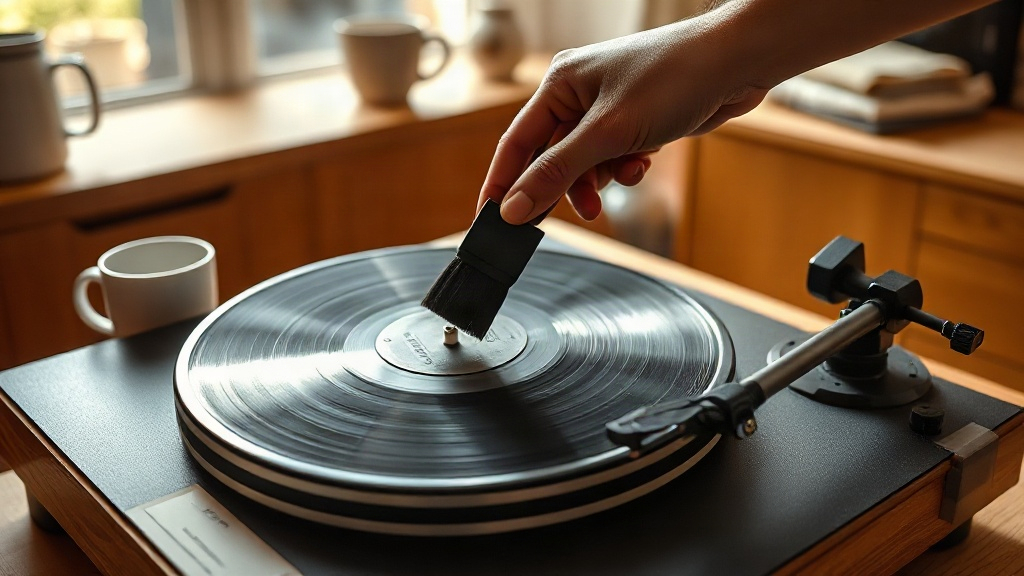
A carbon-fibre record cleaning brush packs dense conductive fibres into a thumbnail-sized head. They collect loose surface dust mechanically and, because carbon is conductive, bleed off electrostatic charge. That second part matters: vinyl builds static during playback and in the sleeve, attracting dust back within minutes. A brush that only removed dust but left the charge would fight a losing battle.
Run the brush along the groove in the direction of the run-in groove (counter-clockwise from above), let the fibres collect what’s on the surface, and lift it away without dragging material back. A few passes is enough. Keeping a brush by the turntable and using it before every play means the needle isn’t fighting fresh debris.
A carbon-fibre brush does not remove fingerprints, dried grease, or grime that’s been sitting for years. Run it over a contaminated record and the surface dust is gone but the record still sounds poor—the crackle was never from loose dust. That gap is where the decision between methods lives.
Spray cleaners: a damp middle ground
Spray cleaners sit between a dry brush and a full wet clean in effort, but not in results. They disperse a solution—typically distilled water and a surfactant to break down oils—across the surface. The spray-and-wipe method then removes dissolved contamination with a pad.
The limitation is the same as any wipe-based approach: it relies on even pressure and full coverage, and doesn’t address drying time. Residue is the main risk—too much fluid or insufficient wiping leaves a film that attracts dust or reaches the stylus.
Spray is most useful for targeted intervention: a visible fingerprint, sleeve transfer, or localised contamination that doesn’t warrant a full wet clean. For a collection of used records from charity shops, it’s a halfway measure that satisfies neither job well.
Wet cleaning: dissolving what brushes can’t shift
Wet cleaning with a solution and a manual kit or machine is the only method that genuinely dissolves embedded contamination. The solution breaks down oils or oxidation; the physical action (vacuum, roller, cloth) carries the dissolved material away.
The results are measurable. A record that crackles after brushing but goes quiet after a wet clean (using a manual Spin Clean (paid link)-type kit or a machine like the Okki Nokki (paid link)) was never carrying loose dust—that crackle was embedded contamination. With used records bought in batches, the pattern is consistent: the brush reduces noise, the wet clean brings it closer to what the pressing should sound like.
See Spin Clean on Amazon → (paid link)
The constraint is time. Wet cleaning requires setup, fluid and drying. For more than one record it’s a process that doesn’t scale easily—a manual bath-style washer like the Knosti Disco-Antistat (paid link) is effective but slower than people expect, especially drying time. For fifty records before a session, this matters. For one grimy record, it’s proportionate.
See Knosti Disco-Antistat on Amazon → (paid link)
Spray cleaners and record cleaning kits sit on a spectrum—the Spin Clean (paid link) and SPINCARE machines are wet methods needing more effort than a spray but delivering better results. Ultrasonic options (HumminGuru (paid link), TGTHDD (paid link)) automate the process but cost more, with buyer feedback flagging build quality and uneven drying.
Buy HumminGuru on Amazon → (paid link)
Which method for your situation
These are sequential tools for different problems, not competing methods.
Dry carbon-fibre brush before every play on records you’ve cleaned and play regularly. This maintenance habit keeps the stylus clear and the groove free of fresh contamination. For records in sleeves between plays, a single pass before each side takes moments. A branded brush is a modest one-off cost covering hundreds of plays.
Wet cleaning is for records new to you and visibly contaminated, or that crackle audibly after brushing. This method suits charity shop finds, records stored without inner sleeves, and pressings sounding worse than they should. A manual kit or machine is a bigger investment than a brush, with automated machines higher again, but for anyone building a used vinyl collection, it unlocks the most audible improvement.
Spray cleaner works for localised contamination when a full wet clean isn’t practical. It’s the method most likely to leave residue if applied carelessly, and has the least dramatic results, but fits spot treatment.
The decision also depends on your setup. A small collection of twenty to thirty relatively clean records needs a brush and occasional wet clean with a manual kit. A larger collection, or regular buying of used vinyl, shifts economics toward a dedicated wet-cleaning solution—a manual Spin Clean, an Okki Nokki (paid link), or the SPINCARE machine as a budget option with noted build trade-offs.
Check Okki Nokki price → (paid link)
If a record is warped, a wet clean won’t fix it, and cleaning it in a Spin Clean risks fluid pooling unevenly or the record not drying flat. Sort the warp first, or accept the clean won’t be perfect.
What other guides miss
Common advice to “just brush your records” is right about the brush but incomplete about when it stops being enough. Guides saying “wet clean everything” are right about results but wasteful on records a brush would sort. The real answer is a sequence—getting it right costs less because you don’t buy expensive kit for jobs a brush handles.
Another overlooked point is static. A record just wet cleaned and dried often has less static than a dry-brushed one, because the process removes charge with the contamination. This means a wet-cleaned record stays clean longer in the sleeve. It’s not the primary reason to wet clean, but a real secondary benefit.
The residue issue with spray cleaners is a practical risk. Apply too much fluid or wipe too quickly and it leaves a fine white residue attracting dust. The fix is simple—less fluid, more patience—but not something to discover mid-listen.
Common questions
Can I use a carbon-fibre brush on a brand-new sealed record?
Yes—and you should. Sealed records accumulate dust in the sleeve before opening, and the outer sleeve introduces fibres during opening. A brush before first play removes this without fluid risk. Don’t open a sealed record and drop the needle without checking—surface contamination can be audible on first play.
Is isopropyl alcohol safe for cleaning vinyl records?
Isopropyl alcohol appears in forum advice, and some commercial products include it diluted. However, it’s a solvent—it can affect certain record compounds and older equipment rubber. If a product contains it, check the label and follow dilution guidance. For uncertainty, a purpose-made record cleaning solution is safer. Distilled water with a small surfactant amount is the basis of most specialist vinyl cleaners and gentler on the groove.
How often should I wet clean a record?
No fixed frequency—it depends on storage, play frequency, and conditions. Records in inner and outer sleeves in a temperate, dry environment need it less than those loose in stacks or damp conditions. Roughly, wet clean records when bought used, when audible noise isn’t fixed by brushing, or when visibly contaminated. Routine brushing handles between-play maintenance.
Does wet cleaning damage records?
No—done correctly, it’s the gentlest deep-cleaning method. The risk is in drying, not cleaning. A record not fully dry before playback can transfer fluid to the label or spindle, and fluid in the groove affects playback. Follow drying instructions for your kit, and don’t rush. Ultrasonic cleaners can dry unevenly on some units—if a record sounds different in the run-in groove than later, drying may not have been uniform.
My record still crackles after wet cleaning. What’s wrong?
Two possibilities. First, contamination may have been deep-seated oxidation or groove wear cleaning can’t remove. A wet clean addresses the groove wall; it can’t repair a worn groove. Second, the stylus may be the source. A worn or damaged stylus can generate the same sounds as a dirty record. If crackle tracks with the stylus path on every record, swap the stylus before assuming cleaning failed.
Cleaning Method Comparison
| Method | Primary Use | Best For | Effort Level |
|---|---|---|---|
| Carbon-fibre Brush | Loose surface dust | Daily maintenance, between plays | Low |
| Spray Cleaner | Localised contamination | Spot treatment, fingerprints | Medium |
| Wet Clean | Embedded grime & oxidation | Deep cleaning, used records | High |
| Ultrasonic Cleaner | Automated deep clean | Bulk cleaning, convenience | High |
| Spin Clean (paid link) | Manual wet cleaning | Budget-friendly deep clean | Medium-High |
Putting the sequence into practice
The sequence is simpler than most advice makes it: brush before every play, wet clean when brushing isn’t enough, and use spray as a spot fix. That order—dry brush, then wet clean, then spray—saves money, because you only set up a wet clean for records that genuinely need it.
Economically, the right method is the cheapest one that removes your contamination. A carbon-fibre brush costs under £20 and lasts for years of daily use. A manual wet-cleaning kit like a Spin Clean runs around £70-£100. An automated machine starts around £300. If a brush solves the problem, you’ve spent £20, not £300. If you need the wet clean, the £70 kit does the job without the machine’s cost. The spray sits in the middle for spot jobs, but isn’t a primary solution. Match the method to the contamination, not the other way around.
If you’re building a cleaning habit from scratch and want a clear outline of what to check and when, the free Record Care Checklist walks through the signs a record needs a brush, the signs it needs a wet clean, and the basics of doing each properly without buying anything you don’t yet need.
Now you know which method your records actually need—Get the Free Record Care Checklist to put the sequence into practice.
Related reading
For a complete overview, see our How to clean vinyl records at home: what actually works, what damages them, and what to skip .
References
As an Amazon Associate we earn from qualifying purchases. The products linked above are ones we recommend based on independent research and owner feedback.
Note: General guidance only, verify details with a qualified professional or official source.