Cleaning charity-shop and second-hand records before their first play
As an Amazon Associate we earn from qualifying purchases. Some links on this page are affiliate links, which means we may earn a small commission if you make a purchase.
Unknown hands, unknown storage, and unknown prior cleaning attempts each leave a residue a dry brush cannot reach. That charity-shop record might look almost fine—a light film of dust, maybe a sticker to peel off—but when the stylus drops, it finds forty years of accumulated grime packed into grooves narrower than a human hair. The stylus doesn’t just play the record; it plays the contamination too.
Most advice skips the critical part: cleaning a second-hand record isn’t optional hygiene. It’s the difference between hearing what the pressing can do and hearing what the last owner left behind. A dry brush before first play clears surface dust but does almost nothing for the grime bonded to the groove wall. The record looks cleaner. It sounds the same.
The good news is that a proper clean before first play is genuinely a one-time job. Once the grime is gone and the record is stored correctly, a quick dust-off before each play is enough to keep it that way. Here’s how to do it properly, what to use, and what to watch out for.
The dry brush’s limitation on a second-hand record
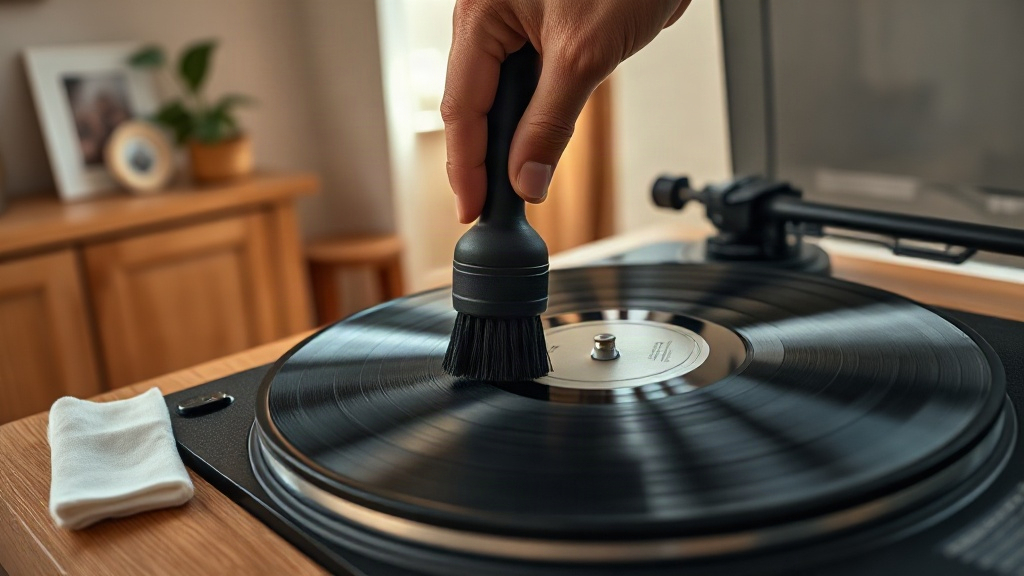
A carbon-fibre brush works on a simple principle: fine conductive fibres collect loose surface dust and help reduce static charge. For a record that lives in a clean sleeve and gets brushed before every play, this maintenance genuinely reduces pops and crackles from static-lifted dust.
But a second-hand record from a charity shop bin, car-boot table, or loft stack isn’t that record. Surface dust is the minor problem. The major issue is what’s embedded in the groove: skin oils, smoke residue, airborne grime from decades in unconditioned homes, and the cumulative effect of being handled by people who had no reason to be careful.
A carbon-fibre brush touches the top of the groove. It cannot reach what’s packed into the groove wall. When the stylus drops into a contaminated groove, it pushes grime ahead and drags some through. The result isn’t silence—it’s a record that sounds like it has surface noise when it actually has a dirty groove.
Static reduction also has limits on a contaminated record. The Milty Zerostat Anti-Static Gun (paid link) can reduce charge on a clean record, cutting down dust attraction between plays, as noted in Milty’s product guidance. But on a record already holding contamination, reducing static is helpful maintenance, not rescue.
See Milty Zerostat Anti-Static Gun on Amazon → (paid link)
Choosing your cleaning approach
Honest advice most product pages avoid: the right method depends on how dirty the record is, how many you’re cleaning, and your budget. No single tool wins every situation.
Most owners settle on a two-tool system: a wet clean for the first pass on a second-hand record, then a carbon-fibre brush for everyday maintenance. That’s not upselling—it’s the job division.
Wet cleaning uses a liquid solution to dissolve and lift grime from the groove wall, followed by drying. It takes longer than brushing but actually cleans a contaminated groove. The Knosti Disco-Antistat (paid link) is a common entry point. Knosti states it uses a washing tray with integrated goat hair brushes and cleaning fluid to squeeze the record in a wet bath. Results on restored used records are noticeable—less crackle, clearer sound. The catch is it’s manual and budget models feel their price. For a more solid option, the Okki Nokki ONE (paid link) is a collector’s tool that restores decades-old records effectively.
View Knosti Disco-Antistat on Amazon → (paid link)
For batch cleaning charity-shop finds, systems like the Spin Clean Record Washer MKII (paid link) handle multiple records per session. The fluid gets murky with use and drying cloths need changing, but it’s relatively straightforward. If budget is tighter, the SPINCARE Vinyl Record Cleaning Machine (paid link) works on dusty, neglected records. It’s a consideration for someone starting with a stack of £2 finds, where cost-to-result maths differ from cleaning a £200 collection.
Buy SPINCARE Vinyl Record Cleaning Machine on Amazon → (paid link)
For lightly dusty recent purchases that look clean, a carbon-fibre brush might suffice as a first pass. The Pro-Ject Brush IT (paid link) handles pre-play dust removal and static. But if the record sounds noisy after brushing, that indicates it needed a wet clean.
View Pro-Ject Brush IT on Amazon → (paid link)
The rule: if you don’t know the history, clean it wet. If bought from someone who clearly cared for it and it sounds clean after brushing, the brush was enough.
Executing a proper first clean
The effective method is wet cleaning with a suitable solution and a purpose-built system or hand application. The fluid choice matters—plain tap water can leave mineral residue, and household detergent may introduce contamination. The standard approach uses distilled water mixed with a dedicated record cleaning fluid like Pro-Ject Wash-It 2, designed to dissolve grime without residue. Using a system’s recommended fluid rather than plain water makes an audible difference—the fluid does chemical work water alone cannot.
With a Knosti-style manual approach, the sequence is: apply diluted cleaning fluid to the brushes, lower the record into the bath, and rotate it through the brushes by hand. Lift it out, let fluid drain, and stand it in the drying rack. Leave it until completely dry. Knosti’s guidance and general record-care advice support avoiding heat from hair dryers or radiators, as heat can warp a record. A few hours in a drying rack is realistic.
With a Spin Clean or similar tray system, the process is batch-oriented: place the record, pump fluid through brushes, rotate, lift, dry. The included drying cloths work but get wet quickly with multiple records—keep spares or a clean microfibre cloth handy.
No cleaning method fixes scratches or badly worn grooves. Cleaning removes contamination; it cannot repair physical damage. If a record skips consistently in the same place on every track, that’s likely groove wear or a scratch—cleaning won’t resolve it.
Cleaning reveals the pressing’s actual condition. Once a record is clean and quiet, you can hear whether damage exists or it was just dirty. That’s valuable for anyone building a collection from charity shops and car boots.
Maintaining a clean record
After a proper wet clean and correct storage, maintenance drops significantly. You’re managing surface dust and static between plays—exactly what a carbon-fibre brush handles.
Technique matters. Hold the brush with fibres against the record, lower the needle onto it, let the record spin a couple of rotations. This collects dust from groove tops and allows static reduction before playing. Lift the brush away, spin the record once or twice without it to release collected dust, then play.
Doing this consistently—not just when the record looks dusty—reduces surface noise on well-maintained vinyl. The Pro-Ject Brush IT and SPINCARE carbon fibre brush both handle this task adequately for routine use. Neither compensates for a record that should have been wet cleaned.
In dry rooms—central heating on full blast in winter—static becomes a persistent problem. The Milty Zerostat Anti-Static Gun is worth considering in that situation. Milty’s product description says it reduces static and the crackle that comes with it, though it requires a slow, deliberate release technique.
A dry brush clears surface dust but cannot reach grime packed into the groove wall. Never speed up drying with a hair dryer or radiator. Heat can warp a record, making it harder to play.
Avoiding common errors
The most frequent error is thinking a dry brush has done the job. You run it across, fibres pick up dust, the record looks better, you play it. It sounds the same. For a contaminated second-hand record, a brush is pre-play maintenance, not cleaning.
Using the wrong fluid is another misstep. Household cleaners, full-strength isopropyl alcohol, and plain tap water can introduce residue, chemical interactions, or minerals left in the groove. Dedicated record cleaning fluid is a modest cost that does the job properly. A solution like SPINCARE Record Cleaner Solution works with SPINCARE kits or similar manual systems, and a small amount goes a long way.
See SPINCARE Record Cleaner Solution on Amazon → (paid link)
Rushing the drying phase is a third mistake. Playing a record that isn’t fully dry means pushing fluid into the groove ahead of the stylus—fluid that may carry dissolved grime. If the record isn’t dry to the touch with no surface coolness, it isn’t ready. A few hours in a drying rack isn’t optional.
A fourth error is assuming cleaning a warped record will help it play. A warped record is a physical problem. Cleaning won’t un-warp it. Consistent with record-care guidance, cleaning does not repair physical defects. If a record wobbles on the platter, the warp needs addressing, not just the grime.
Understanding the limits of cleaning
Cleaning removes contamination from the groove. It does not repair a worn groove, fill a scratch, or restore lost high frequencies from groove deformation. If a record sounds muffled or flat after a thorough clean, that’s likely the pressing—from a worn stamper, heavy previous play, or simply not a great recording.
A useful test for charity-shop records: after wet cleaning and drying, play the first thirty seconds of side one, typically the quietest part. A clean, quiet record with persistent crackle throughout every track isn’t dirty—it’s worn.
This changes what you do next. A worn record doesn’t need another clean. It requires acceptance that it’s a played copy, or finding a better one.
If a record skips consistently in the same place on multiple tracks, that’s usually a warped centre label area, damaged groove, or tonearm setup issue. Cleaning won’t fix a skip. Try the record on a different deck if possible; if it skips there too, the record is the issue.
When choosing a cleaning fluid, tap water isn’t ideal—it contains minerals that can leave residue as it dries. Distilled water is the base for most dedicated cleaning fluids. Using a pre-mixed solution like Pro-Ject Wash-It 2 with distilled water is standard. If using a system like Spin Clean, follow the maker’s guidance on fluid ratios. If a record sounds noisy—crackly, gritty—before playing, that’s not surface dust but contamination in the groove. A brush removes what sits on top; bonded grime needs a wet clean to dissolve and lift. When in doubt, clean it wet. A brush might suffice only for a record that looks and sounds clean from a known, well-stored source. Once a record is clean, it should almost never need thorough cleaning again. With proper storage and maintenance, a record should need thorough cleaning only once. What changes is surface dust between plays, handled by brushing. If cleaning a record repeatedly, check if the storage method (sleeves, upright, away from heat) is working. Surface appearance poorly indicates groove condition. A record can look clean but have significant contamination from smoke, airborne grime, or handling oils. The clean-before-first-play rule applies to any second-hand record, regardless of appearance. After the first wet clean, once dry, store it properly: a new or clean inner sleeve (anti-static preferred), a sturdy outer sleeve if protecting the cover, and upright—never flat or leaning. Then brush before each play. That’s the system. A properly stored record after a thorough clean doesn’t accumulate contamination requiring another wet clean.

Cleaning Method Comparison
| Method | Best For | Time Required | Notes |
|---|---|---|---|
| Wet Clean | Heavily contaminated records | 20-30 mins per side | Dissolves bonded grime; requires drying rack |
| Carbon Brush | Daily maintenance | 30 seconds | Clears surface dust; does not remove embedded grime |
| Spin Clean (paid link) | Batch cleaning multiple records | 20-30 mins per batch | Efficient for stacks; fluid gets murky with use |
| Okki Nokki ONE (paid link) | Restoring old records | 20-30 mins per side | Higher build quality; effective for 40+ year old records |
| SPINCARE Machine | Budget-friendly cleaning | 20-30 mins per side | Results are modest; build quality varies |
| Milty Zerostat (paid link) | Reducing static in dry rooms | 30 seconds | Requires deliberate technique; not a cleaning method |
| Pro-Ject Brush IT (paid link) | Routine dust removal | 30 seconds | Solid build; effective for pre-play dust removal |
The pre-purchase test
Before buying, tilt the record under a shop lamp so the surface itself says which pile it belongs in. The raking light reveals hazing, fine scratches, and warp you’d miss under flat light. A charity-shop record is one of the better deals left in the UK. A £3 find properly cleaned before its first play can sound better than things three times the price still in shrink wrap. The method isn’t complicated—wet clean once, brush before every play after, store it upright. The one-time clean is the investment that makes everything after easier.
If building a collection from second-hand sources and wanting a clear rundown of what to check and clean at each stage, the free Record Care Checklist covers the full sequence—from inspecting a charity-shop find to storing it properly once it’s playing cleanly.
Get the Free Record Care Checklist and you’ve got a reference you can work through every time you bring a stack home.
Related Guides
For a complete overview, see our How to clean vinyl records at home: what actually works, what damages them, and what to skip .
Sources & Further Reading
As an Amazon Associate we earn from qualifying purchases. The products linked above are ones we recommend based on independent research and owner feedback.
Note: General guidance only. Always verify details with a qualified professional or official source.