A record skipping in the same spot: scratch, warp or dirt in the groove?
As an Amazon Associate we earn from qualifying purchases. Some links on this page are affiliate links, which means we may earn a small commission if you make a purchase.
A skip at the same point every play points to the record; a skip that moves around points to the player. That distinction is the organising principle for this diagnosis. When the needle jumps at the exact same chorus or bridge, it’s not a random fault—it’s a specific signal about what’s happening in that groove.
Here’s how to decode that signal. By the end, you’ll know whether the skip is caused by dirt, a worn needle, a warp, or a scratch, and which fix is actually worth your money.
Isolating the Problem: Record or Player?
First, establish where the problem lives. A skip tied to one record suggests a fault with the vinyl itself. A skip affecting multiple records points to the turntable.
The simplest test is to swap the components. Play a record you know plays cleanly on another system on your own turntable. If it skips, the issue is likely your player. Next, play the problematic record on a different turntable. If it skips there too, the record is the culprit. This basic test prevents the common mistake of replacing a cartridge when the stylus alone was worn out.
What the results mean:
- Skip on your player only, with every record → stylus or tonearm issue.
- Skip on your player only, with one specific record → dirty record or pressing defect.
- Skip on every player, with one specific record → warp, scratch or manufacturing fault.
Visually inspect the record under a light. A scratch running parallel to the groove is a physical defect no cleaning will fix.
When the Stylus is the Culprit
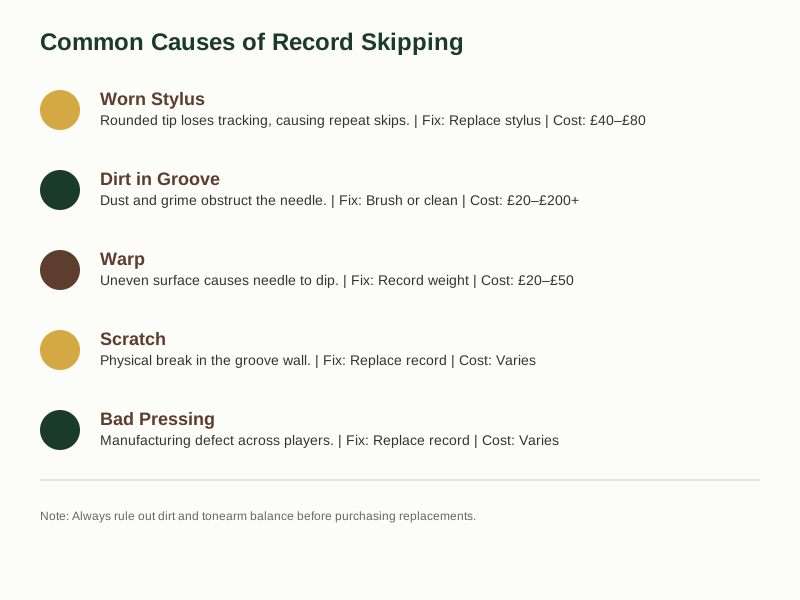
The most overlooked cause of a repeat skip is a worn stylus. A sharp, new stylus tip tracks the groove modulation precisely. Over time, the tip rounds off. This blunt tip can’t follow the groove properly, especially in dense musical passages or inner-groove sections, causing it to jump out at the same spot every time. The record isn’t broken; the needle is.
Continuing to play with a worn stylus doesn’t just cause skips—it permanently wears down the groove walls. A familiar pattern is assuming a record is faulty, buying a replacement, and finding the new copy skips in the same place. Swapping the stylus fixes both records, confirming the needle was the problem.
Check the stylus under a magnifying glass or bright light. A new tip is a sharp point; a worn one looks rounded and shiny. Increased crackle and distortion are also tell-tale signs of wear. If your deck has seen regular use for over a year, the stylus is a prime suspect.
Replacement costs vary by cartridge. For entry-level models like those using an Audio-Technica ATN3600L (paid link) stylus, the cost is typically modest. For mid-range cartridges in the VM95 series, the Audio-Technica AT-VM95E (paid link) is a direct replacement. Owners of an Ortofon 2M Red (paid link) can replace just the stylus, with the 2M Blue offering a recognised upgrade path.
See AT-VM95E on Amazon → (paid link)
Addressing a Dirty Record
If the record is the problem and the stylus is fine, dirt in the groove is the next likely cause. Dust and grime physically block the stylus. A proper clean can often resolve the skip without further intervention.
For daily maintenance, a carbon fibre brush like the Pro-Ject Brush IT (paid link) effectively removes surface dust and reduces static crackle before each play. It handles surface dust but not embedded grime.
View Pro-Ject Brush IT Carbon Fibre Record Cleaning Brush on Amazon → (paid link)
For used records with visible grime, a cleaning machine can make a significant difference. The manual Okki Nokki ONE (paid link) is designed for serious collectors. The Spin Clean Record Washer MKII (paid link) offers a budget-conscious, non-electric solution for batches of second-hand vinyl, though its effectiveness varies with the condition of the pressing.
See Spin Clean Record Washer MKII on Amazon → (paid link)
It’s crucial to understand that no cleaning method fixes a scratch, which is a physical break in the groove. Cleaning removes contaminants; it cannot repair structural damage.
Choosing a method:
- Quick daily maintenance → carbon fibre brush.
- Used vinyl in batches → consider a cleaning machine.
- Deep contamination → a wet-cleaning system is necessary.
After any wet clean, ensure the record is completely dry before returning it to its sleeve to prevent immediate dust attraction.
The Challenge of a Warped Record
A warp causes a skip differently. As the warped section rotates, the stylus loses contact with the groove wall and jumps. The skip occurs at a fixed radial position corresponding to the warp.
While heat and pressure methods are discussed online, they carry a high risk of causing permanent damage. PVC, the material of records, can be permanently deformed by incorrect heat application. Safer approaches involve a record weight or specialised flattening mat, which apply even pressure over time without heat. These can sometimes correct a mild warp enough for proper tracking.
This should be a last resort. A heavily warped record may never play perfectly, and replacement is often a more sensible option if the record is readily available.
Physical Damage and Pressing Faults
A visible scratch is a clear indicator of physical damage. If the needle is jumping over a scratched section, the record needs to be replaced or the section worked around manually.
In rare cases, a skip can be caused by a manufacturing defect in the pressing itself. If a brand new record skips on multiple, well-set-up turntables, it may be a faulty pressing warranting a return or exchange.
Common Questions Answered
Can a hairdryer fix a warped record?
Using a hairdryer is not recommended. The heat can permanently deform the vinyl, often making the warp worse. A record weight or flattening mat applied over time is a safer, though not guaranteed, method.
Does a cleaning machine fix scratches?
No. Cleaning machines remove dirt from the groove wall. A scratch is physical damage to the groove itself, which cleaning cannot repair.
How can I tell if my stylus is worn out?
Inspect the tip under a bright light. A worn stylus appears rounded and polished rather than sharp. Audible signs include increased crackle, distortion, or a general loss of clarity. If you’ve used the same stylus for over a year of regular play, replacement is advisable.
Taking Action
Ultimately, a scratch or a warp belongs to the record itself—these are often permanent. Dirt in the groove is a handling issue you can fix. But if the skip is due to a worn stylus, that fault belongs to the player, and it’s the one thing you can still correct tonight to prevent further damage to your collection. Start by checking the stylus.
Get the Free Record Care Checklist to work through the full diagnostic sequence, including detailed stylus inspection and cleaning steps.
Further Reading
For related troubleshooting, see our guide on why brand new records skip .
Sources & Further Reading
As an Amazon Associate we earn from qualifying purchases. The products linked above are ones we recommend based on independent research and owner feedback.
General guidance only. Always verify details with a qualified professional or official source.