Should you store vinyl records flat or upright? What actually causes warping

The debate about ‘flat or upright’ record storage often misses the point because it treats orientation as a single decision. In reality, you’re making two separate choices: how the record faces (upright vs flat) and how well it’s supported laterally. The confusion happens when people assume upright storage automatically means proper support, or that flat storage is inherently risky regardless of conditions. Understanding this distinction explains why the argument never settles—people are talking about different variables.
When you pull a record from the shelf and notice a gentle bow in the middle, followed by new skips during playback, the storage question becomes urgent. Both sides of the debate sound confident, but most advice skips the actual mechanism. This leaves you following rules inconsistently, and your records suffer the consequences.
Here’s how heat and pressure actually deform vinyl, and why upright storage with proper support is the only reliable approach.
Understanding the pressure problem
There are two basic ways to position a vinyl record. Standing it on its edge with the label facing out is upright storage. Laying it flat, often with other records stacked on top, is flat storage. Many people default to flat storage because it looks tidier or seems space-efficient.
The verdict comes down to pressure distribution. When a record sits flat, its entire surface contacts whatever is beneath it—another record, a shelf, or a slipmat. Any weight pressing down on the stack creates uneven force across the vinyl. A record isn’t rigid; it’s a thin plastic disc that flexes under load. Over months or years, that flex becomes permanent deformation. The edges stay flat while the centre bows upward, creating the classic warped record. Once set, this shape doesn’t recover.
Upright storage eliminates this pressure entirely. A record standing on its edge bears its own weight along a narrow line at the outer edge—the part that matters least for playback. The groove area remains clear of pressure.
The exception worth noting: flat storage can work with perfectly controlled conditions—cool, dry, and absolutely no external load. No records stacked on top, nothing pressing down. In practice, this is difficult to maintain consistently. Radiators cycle, someone places a box on the shelf, or a humid summer afternoon softens the plastic just enough. The conditions for safe flat storage are too fragile to rely on regularly.
What makes vinyl vulnerable to warping
To understand why orientation matters, you need to know what happens to the vinyl material itself. The disc is made from polyvinyl plastic, which is inherently sensitive to heat. Vinyl softens at temperatures far below what feels hot to the touch. A shelf near a radiator, a record left in a car on a sunny afternoon, or a stack in a warm room—these seemingly harmless conditions can cause damage.
Add pressure to warmed vinyl, and deformation occurs. When the plastic is soft enough and something presses on it—the weight of another record, a leaning neighbour, or a box on top—the material changes shape. This isn’t a manufacturing defect; it’s the physics of flexible plastic under load at elevated temperature.
Heat, pressure, and unsupported leaning compound each other. Heat alone rarely warps a record without pressure. Pressure alone might not cause permanent damage unless the vinyl has softened. But together—a warm room with heavy stacking, or a leaning record bearing weight against a shelf edge—creates the perfect conditions for permanent deformation.
Upright storage removes the pressure element from this equation. The record stands freely, its weight distributed along the edge, with nothing pressing on the playing surface. This explains why the “flat is fine if you don’t stack” argument fails in practice. Even without stacking, a record lying flat can still warp if the shelf isn’t level, if the record has a slight cup from pressing, or if it sits near a heat source.
Setting up proper upright storage
Storing records upright is the right approach. Here’s how to implement it effectively.
Choose shelving that prevents leaning. Solid wood shelves, high-density plastic units, or purpose-built record storage furniture keep records vertical and supported. The shelf should be deep enough that records don’t overhang the front edge where they could be knocked or lean.
Maintain full support. Records in a partially filled shelf will lean and bow against each other. Fill the shelf reasonably full, or use a bookend to keep everything vertical. Soft foam or wooden dividers can help keep records in place without applying hard pressure.
Control humidity levels. Aim for around 40–50% relative humidity for vinyl storage according to preservation guidelines. Damp conditions can affect both records and sleeves. A dehumidifier in a storage room helps protect records among other items. Keep records away from direct sunlight and radiators—both are heat sources that accelerate softening.
Check regularly for leaning. If a record leans, it’s under pressure and will warp over time. A leaning record also pressures its neighbours, creating a cascade effect. Correct this immediately—it’s a quick fix that prevents long-term problems.
Avoid these common mistakes: Don’t store records in shipping mailers long-term—cardboard can absorb moisture. Don’t use cheap paper sleeves that shed fibres; poly-lined inner sleeves better control static. Don’t leave records on the turntable between plays—the platter isn’t storage.
Now you know what to look for—Get the Free Record Care Checklist to audit your collection and ensure proper storage.
When flat storage might work
Flat storage isn’t inherently wrong—it works for short-term situations like a record you’ve just played but haven’t filed yet, or a small stack you’re actively working through. The risk comes when it becomes the default method for an entire collection.
The dangers are real. Flat storage concentrates heat-induced softening across the entire playing surface. A record that warps while flat develops a bowl shape—centre bowed up, edges down—causing skipping, especially in inner grooves. Once one record in a stack warps, it can press down on those beneath it, spreading damage. Owners who’ve lost entire stacks describe this domino effect as sudden and frustrating.
Flat storage is acceptable only under specific conditions: a single record on a perfectly flat, level surface in a cool, dry environment with nothing on top for a limited period. For most households, with central heating cycles and shelves that aren’t precision-levelled, upright storage remains the only approach that doesn’t require maintaining conditions most people can’t guarantee.
Comparing storage approaches
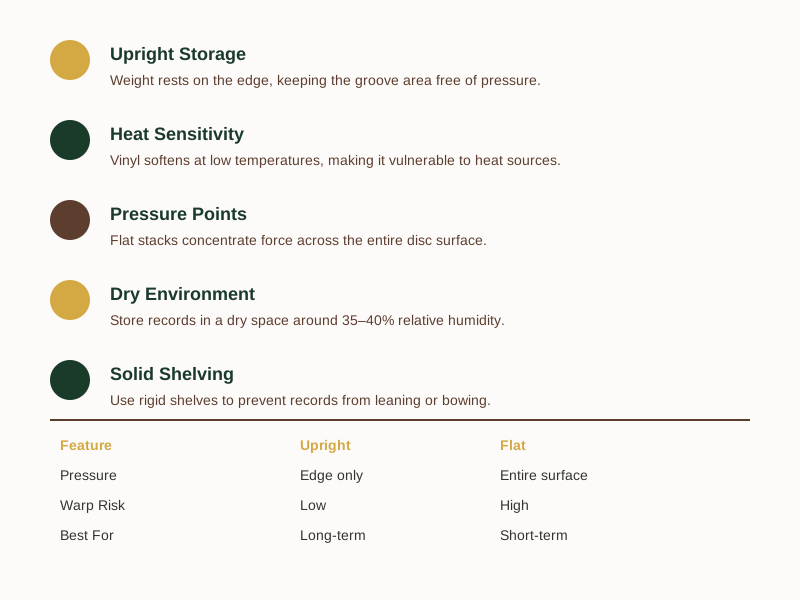
In summary, upright storage places weight only on the record’s edge, resulting in a low warping risk and moderate space efficiency, making it best for long-term collections. Flat storage places weight on the entire surface, carries a high warping risk, and is highly space-efficient, making it suitable only for short-term use.
Common storage questions
Are plastic sleeves good for records?
Yes—poly-lined inner sleeves protect vinyl from dust and static better than the paper sleeves included with many new pressings. Use poly-lined sleeves rather than plain plastic, which can trap moisture. Replace sleeves when they become worn or dirty.
Does record thickness affect storage needs?
Not significantly. All standard vinyl records are vulnerable to the same heat-and-pressure mechanism. Thicker pressings (180g) have more material to flex, making them slightly more resistant to warping, but they’re not immune. The same storage rules apply to all weights.
Can a warped record be fixed?
Usually not. A warped record causes the stylus to ride up and down in the groove, producing skipping, distortion, and increased groove wear. The deformation is permanent—flattening attempts rarely restore the original shape without further damage. A severely warped record is effectively lost, making prevention through correct storage crucial.
Implementing proper storage
The essential practice is straightforward: store records upright on solid shelving in a dry, cool space, and regularly check that none are leaning. This single habit does more for collection longevity than any cleaning tool or accessory.
The physics is simple—heat softens vinyl, pressure deforms it, and upright storage removes the pressure. Once you understand this mechanism, the rule stops feeling arbitrary and becomes common sense.
If you’re ready to evaluate your own collection against these principles, get the free Record Care Checklist. It provides a straightforward way to audit what you have, spot records needing attention, and ensure your storage is effective.
Further reading
Quick answers:
Detailed guides:
- Inner and outer sleeves: which ones are worth buying and which are marketing
- Can you fix a warped record? Heat, hair dryers and what really works
- Is it safe to keep records in a loft, garage or shed? Cold, damp and heat
References
Note: General guidance only, verify details with a qualified professional or official source.