What the ground wire on a turntable does, and why the hum comes back without it

As an Amazon Associate we earn from qualifying purchases. Some links on this page are affiliate links, which means we may earn a small commission if you make a purchase.
Once cables are reseated and a low steady hum remains, exactly one suspect is left — the chassis return path — and the ground wire is that path.
You’ve checked the RCA cables. You’ve swapped the interconnects. The hum persists, low and steady, riding underneath everything you play. In a turntable setup, this narrows the field fast. The signal path is simple: cartridge, tonearm wiring, RCA out. When that path is intact and the noise remains, the current has found another route to earth — one that runs through the metalwork of your amplifier and back out through your speakers.
The ground wire exists to give that current a shorter, preferred path. Without it, the chassis of your turntable and the chassis of your amplifier sit at slightly different electrical potentials. The difference might be millivolts, but your phono stage amplifies everything it sees. What you hear is the 50 Hz mains frequency, or its harmonic, humming beneath the music.
The wire itself is nothing special: a single conductor, often with a spade lug or bare end, running from a terminal on your turntable to a grounding post on your amplifier or receiver. Its job is to equalise potential between the two chassis, so no current flows through the signal cables. When it’s connected, the hum vanishes — not because anything is “fixed,” but because the path that carried the noise is now bypassed.
This is why the hum returns when the wire is removed. The system hasn’t developed a fault. The turntable hasn’t degraded. The loop simply reopens, and the current finds the next available route — which, in most setups, is the shield of your RCA cable, then the ground plane of your amplifier, then your speakers.
Where the Loop Actually Forms
The confusion around ground loops often comes from imagining the problem as “too much earth.” In practice, it’s almost always multiple devices trying to reach earth through different paths that meet at the wrong point.
Your turntable’s motor, its internal wiring, and the metalwork of the tonearm all connect to the chassis. Your amplifier’s phono stage, its power supply, and its output stage share their own chassis connection. When both chassis connect to the mains earth — as they must, in any properly wired UK installation — they have two routes to ground. The current will take both, and where those routes share a conductor, you hear the interference.
The RCA cable’s outer shield is meant to be a screen, not a current path. But without a dedicated ground wire, it becomes the bridge. The shield carries not just the tiny signal from your cartridge, but the leakage current from the entire system. That’s the hum.
A dedicated ground wire creates a direct, low-resistance path between the two chassis. The current takes it, because it’s easier. The signal path stays clean.
How to Connect It Properly
Not every amplifier labels its grounding post clearly. Look for a small screw terminal, often near the phono input, sometimes marked with an earth symbol or simply “GND.” On some vintage receivers, it’s a metal tab. On others, it’s a post with a knurled nut.
On the turntable side, the terminal is usually near the RCA output, sometimes on the underside of the chassis. It’s often a simple post with a thumbscrew, designed for a spade connector or a wrapped bare wire.
The order of connection matters for safety, though not for function. Connect to the turntable first, then to the amplifier. This avoids the small spark that can occur if the amplifier end is live and the turntable chassis touches it during connection.
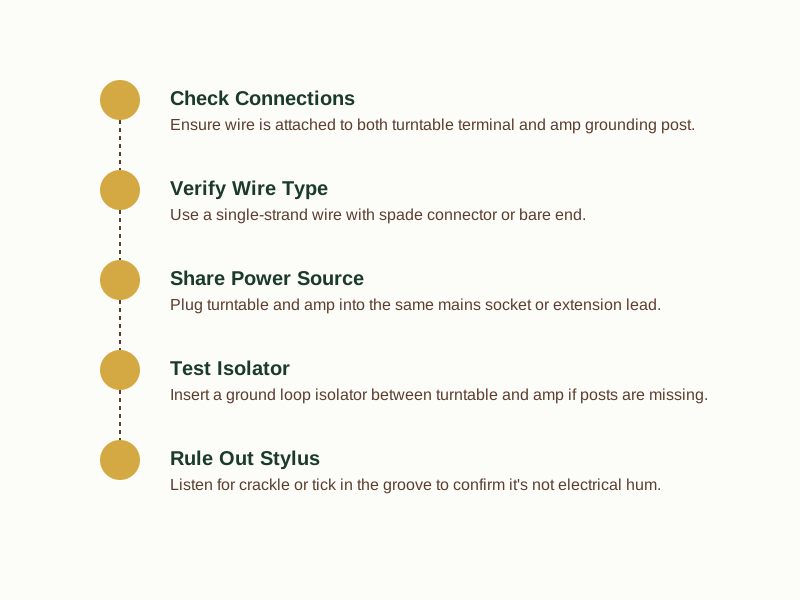
If your amplifier has no grounding post — common with compact integrated amps and most active speakers — you have two options. First, try connecting both units to the same mains socket or extension lead. If they’re on different ring mains, the potential difference between the two earth connections can create the loop you’re hearing. Shared power removes this variable.
Second, if the hum persists, a ground loop isolator (paid link) sits between the turntable and the amplifier and breaks the loop galvanically. It’s not the ideal solution — it adds a component in the signal path — but it’s a legitimate workaround when the grounding post simply isn’t there.
View ground loop isolator on Amazon → (paid link)
When the Ground Wire Makes Things Worse
There’s one exception that catches people out. Some amplifiers — particularly certain models from Rega, some built-in phono stages in integrated amps, and a minority of vintage receivers — have their phono input internally grounded to the chassis. The manufacturer has already made the connection you’re about to make.
In these cases, adding an external ground wire creates a second path. The current now has two routes to choose from, and it takes both. The hum gets louder, or changes character, or appears where there was none before.
If connecting the ground wire increases the noise, disconnect it and listen. If the hum vanishes, your amplifier is already grounded internally. Leave the wire off. Check your manual — it will usually note this configuration, though not always prominently.
This is the exception that proves the rule: the ground wire is the fix, except when it isn’t. The test is empirical. Connect it, listen, disconnect, listen again. The correct configuration is the one that silences the system.
Distinguishing Ground Hum from Other Noises
Not every low-frequency noise is a ground loop. A worn stylus can produce a fuzzy, indistinct quality that’s easy to mistake for hum. Dirty records add crackle and pop, but severe contamination can mask as a continuous noise floor.
Ground hum has a specific signature: it’s a pure tone, or close to it, at 50 Hz in the UK. It tracks with the amplifier’s volume control — turn the volume down, and the hum drops proportionally. This is the key diagnostic. Mechanical noise from a worn stylus doesn’t behave this way. Surface noise from a dirty record doesn’t either.
If you’re uncertain, touch the metalwork of your turntable while the system is playing. If the hum changes — gets louder, quieter, or shifts in tone — you’re hearing a ground loop. Your body has introduced another path to earth, altering the current flow. Remove your hand, and it returns to baseline.
The Real Cost of Leaving It
There’s no damage mechanism here. A ground loop won’t harm your records, your stylus, or your amplifier. What it costs you is the music itself — the quiet passages, the decay of notes, the space between tracks. A persistent hum trains your ear to listen past it, to filter it out. But that filtering is work. You’re no longer hearing the record; you’re working around the noise.
The fix is a wire that costs less than a replacement stylus, often less than a single record. The time spent diagnosing it — checking connections, trying shared power, testing with and without the ground link — is repaid immediately when the hum vanishes and the system simply plays.
If you’re working through a full setup check, there’s a free Record Care Checklist that walks through the key things to verify — including the ground connection, stylus condition, and record cleanliness.
Quick Reference: Ground Wire Checklist
| Step | Action | What to Check |
|---|---|---|
| 1 | Locate terminals | Turntable ground post near RCA output; amplifier ground post near phono input |
| 2 | Connect wire | Spade lug or bare wire to both terminals; turntable first, then amplifier |
| 3 | Test shared power | Both units on same mains socket or extension lead if no ground post exists |
| 4 | Try isolator | Ground loop isolator (paid link) between turntable and amp if hum persists |
| 5 | Check for exception | If hum increases with wire connected, disconnect — amplifier is internally grounded |
Frequently Asked Questions
Can’t I just use the RCA cable’s ground connection?
The RCA shield provides a ground return, but it wasn’t designed to carry chassis currents. Without a dedicated ground wire, that shield becomes the only path, and the current it carries modulates the signal. A ground wire gives the current a separate, lower-resistance route. The RCA shield then does what it was meant to do: screen, not conduct.
What if my amplifier doesn’t have a grounding post?
Try shared mains power first — same socket, same extension lead. The potential difference between separate ring mains is a common loop source. If that fails, a ground loop isolator (paid link) breaks the loop without needing a ground connection. It’s a workaround, not a fix, but it works.
Will a ground wire improve my sound quality?
It removes interference. What follows isn’t “improvement” in the sense of added detail or changed tonal balance — it’s the absence of a masking noise. The music was always there; the hum was sitting on top of it. Take the hum away, and you hear what you paid for.
Why does the hum sometimes get worse when I touch the turntable?
Your body is conductive. When you touch the chassis, you provide another path to earth, altering the current flow through the loop. This is diagnostic: if touching the metalwork changes the noise, you’re dealing with a ground loop, not a mechanical or stylus issue.
Related Guides
- Do you need a phono preamp? The setups where you do, and the ones where you don’t
- Connecting a turntable to a soundbar or wireless speakers without buying the wrong adapter
As an Amazon Associate we earn from qualifying purchases. The products linked above are ones we recommend based on independent research and owner feedback.